



 +86 18681836350
  info@monokj.com


For metal processors and CNC machinists, the choice of material directly impacts machining efficiency, part quality, and bottom-line profitability. Among the vast array of aluminum alloys, one grade stands out as the workhorse of the industry: 6061-T6.
But what makes it the go-to choice for everything from automation equipment to medical devices? Let’s dive into the key characteristics that earn 6061-T6 its title as the “King of CNC Machining.”
6061 aluminum is a precipitation-hardened alloy containing magnesium and silicon as its primary alloying elements. The “T6” designation refers to its heat treatment: it has been solution heat-treated and artificially aged. This process gives the material an ideal balance of strength, corrosion resistance, and machinability.
In its T6 state, 6061 offers a hardness that allows chips to break cleanly without sticking to the cutting tool. This enables: higher feed rates, reduced tool wear, and excellent surface finishes. Machinability Rating: 90% (compared to 45% for stainless steel) — meaning faster cycle times and lower cost per part.
With density just 2.7 g/cm³ (one-third that of steel), 6061-T6 delivers: Tensile Strength ≥310 MPa, Yield Strength ≥276 MPa, Elongation ≥12%. Strong enough for most structural components while keeping parts lightweight — critical in automotive, aerospace, and portable equipment.
Heat-treated 6061 exhibits minimal distortion during machining. Parts hold tight tolerances, and the material accepts subsequent surface treatments beautifully: anodizing, sandblasting, painting, or powder coating.
The natural oxide layer provides good protection against atmospheric corrosion. When anodized, its durability in harsh environments improves dramatically.
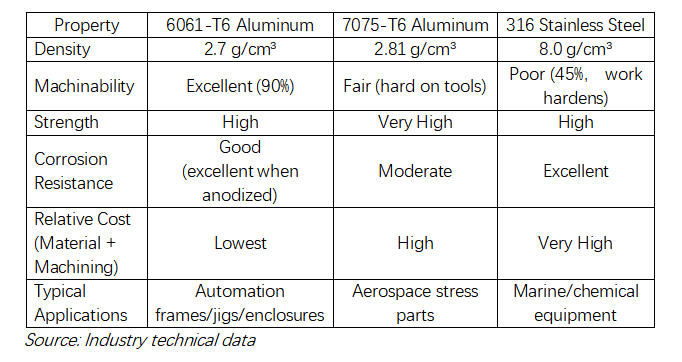
The demand for 6061-T6 is growing, driven by trends relevant to your customers:
· New Energy Vehicle Expansion: EV manufacturers need lightweight structural components and battery enclosures — 6061 is a top choice.
· Precision Manufacturing Boom: Semiconductor equipment, medical devices, and robotics rely on CNC-machined 6061 parts.
· Cost Optimization Pressure: With rising energy costs, processors seek materials that machine faster and extend tool life. 6061-T6 delivers exactly that.
According to market data, China's 6061 aluminum plate market is projected to grow at a CAGR of 8.8% from 2026 to 2032, driven by these very applications.
· Cutting Speeds: Higher speeds are possible than with steel — take advantage.
· Tooling: Carbide tools recommended for long production runs.
· Coolant: While not strictly required, coolant improves surface finish and extends tool life.
· Workholding: Ensure rigid setups to avoid vibration in thin sections.
In an era where manufacturing precision and cost control are equally critical, 6061-T6 aluminum has earned its reputation as the industry's most trusted material. Its balanced combination of machinability, strength, and lightweight properties makes it the default choice for countless applications—from automation equipment to medical devices and new energy vehicle components.
For those specifying or sourcing materials, understanding what makes 6061-T6 perform is essential. Its consistent heat-treated structure delivers dimensional stability that few other alloys can match. Its natural corrosion resistance and excellent surface finish potential reduce post-processing requirements. And its machinability rating of 90% translates directly to faster cycle times and longer tool life.
The numbers tell the story: at approximately $2,800 per ton, 6061-T6 offers exceptional value relative to its performance. But beyond cost, it delivers something equally important — reliability. In precision manufacturing, consistent material behavior from batch to batch is the foundation of quality output.
As downstream industries continue pushing for lighter, stronger, and more precisely machined components, 6061-T6 remains the material that makes it possible. Whether you're designing the next generation of electric vehicles or building precision automation systems, this versatile alloy provides the performance foundation you can count on.